Showing posts with label circuit training workouts for men. Show all posts
Showing posts with label circuit training workouts for men. Show all posts
Circuit Training Basics and Benefits
Circuit training is a method of resistance training, or weight training, that maximizes the volume of work done in a short period of time. Circuit training is a great tool to use for people who are interested in weight loss, muscle gain and overall strength increases.
Circuit training squashes common excuses that people use for not exercising because it takes little time, is action packed, does not need to be done everyday, and it can be personalized.
The amount of weight that a person lifts during a circuit training session can vary between sets. A person can start with light weights and work up to heavier weights (increasing pyramid) or can start with heavy weights and regress to lighter weights (decreasing pyramid). The most important component of circuit training is to take little rest in between sets, whether of the same or different exercises.
Circuit training is also a convenient way to exercise. It maximizes the total exercise volume (number of sets, repetitions, and amount of weight) completed in a period of time. Exercises are completed in a row, and therefore, the time spent exercising is condensed. Separate cardiovascular training is not necessary. All body parts are trained in one session, and therefore, exercisers do not need to work out everyday.
It can be used to achieve an increase in lean body mass and a decrease in weight.

Source: http://www.fitday.com/fitness-articles/fitness/body-building/circuit-training-basics-and-benefits.html
Circuit training squashes common excuses that people use for not exercising because it takes little time, is action packed, does not need to be done everyday, and it can be personalized.
Circuit Training Basics
Circuit training consists of performing multiple exercises on multiple body parts in a row with little rest in between exertions. The two most basic types of circuit training are horizontal training and vertical training. In horizontal training, all sets of one exercise are performed before a person moves on to the next exercise. In vertical training, one set of every different type of exercise is performed before returning to an exercise for the second time.The amount of weight that a person lifts during a circuit training session can vary between sets. A person can start with light weights and work up to heavier weights (increasing pyramid) or can start with heavy weights and regress to lighter weights (decreasing pyramid). The most important component of circuit training is to take little rest in between sets, whether of the same or different exercises.
Circuit Training Benefits
Due to the lack of rest that circuit training demands, exercisers maintain elevated heart rates for the entire period of exercise. The combination of weight training and increased cardiovascular effort makes circuit training a beneficial type of cross training. The exerciser gains muscle through the resistance training. The exerciser increases his/her cardiovascular endurance during the slightly elevated heart rate that is maintained in between sets and throughout the overall program. The exerciser burns high amounts of calories during the high exertion periods of his/her sets.Circuit training is also a convenient way to exercise. It maximizes the total exercise volume (number of sets, repetitions, and amount of weight) completed in a period of time. Exercises are completed in a row, and therefore, the time spent exercising is condensed. Separate cardiovascular training is not necessary. All body parts are trained in one session, and therefore, exercisers do not need to work out everyday.
Long Run Benefits
Circuit training is a type of interval training. Interval training is a great way to increase the body's ability to burn calories when it is at rest. The exerciser's heart rate goes up very high, returns to a lower, but still elevated, state, and then goes up very high again. At no point during circuit training does the heart rate return to its resting rate. Circuit training, and interval training overall, increases the amount of oxygen that a person consumes post exercise, and therefore, increases the number of calories that a person burns throughout the day.It can be used to achieve an increase in lean body mass and a decrease in weight.
Source: http://www.fitday.com/fitness-articles/fitness/body-building/circuit-training-basics-and-benefits.html
Circuit Training Basics
Looking for a way to infuse your fitness routine with some new energy and excitement? Whether you're a seasoned athlete or just getting started with physical activity, circuit training is a great way to challenge your body in a variety of ways while boosting the fun factor.

What Is Circuit Training?
A typical circuit training workout includes about 8-10 exercise stations. After completing a station, instead of resting, you move quickly to the next station. A muscular strength and endurance circuit alternates muscle groups, such as upper body, lower body and core, so little or no rest is needed in between stations. This article focuses on another form of circuit training: aerobic + strength. This type of circuit alternates 1-2 sets of resistance exercise (body weight, free weights, dumbbells, kettle bells, bands, etc.), with brief bouts of cardiovascular exercise (jogging in place, stationary cycling, rowing, etc.) lasting anywhere from 30 seconds to 3 minutes. Depending on your goals and the number of circuit stations, you can complete 1 or more circuits in a 30-60 minute session.Advantages of Circuit Training
Boredom and time constraints are frequently cited reasons for giving up on a fitness routine. Sound familiar? Circuit training offers a practical solution for both. It’s a creative and flexible way to keep exercise interesting and saves time while boosting cardiovascular and muscular fitness. You’ll burn a decent amount of calories too—in a 1-hour circuit training session, a 150-pound person burns about 308 calories at a moderate intensity; and 573 calories at a vigorous intensity. Because the exercises can be performed in any sequence, you can create an endless number of combinations and design every workout to match your mood or specific training goal. Participating in a group circuit-training class is a great way to discover new exercises you might not have tried on your own.At Home
Set up strength and cardio stations indoors or outdoors. Cardio could include going up and down stairs, marching or jogging in place, running up and down the driveway, using home exercise equipment and jumping rope. For strength stations, do push-ups, planks and lunges, using your own body weight. You can also use dumbbells, bands and Kettlebells. For more ideas, look for a fitness DVD featuring circuit-training workouts.At the Gym
Check to see, if your gym offers circuit training classes. You’ll need to move quickly from station to station, so it’s tough to do on your own during regular gym hours when others are using equipment. If you’re working with a certified personal trainer, ask for help in building a custom circuit training workout using a variety of equipment.At the Park
The fitness trail, or parcourse are popular features at many parks across the United States and around the world. This can be considered a form of aerobic + strength circuit training. The parcourse consists of walking trails with exercise stations located along the way. But even if your local park doesn’t have a circuit set-up, you can create your own aerobic + strength circuit by alternating brisk walking, bicycling or running on a trail with push-ups, dips, and squats, incorporating things found in nature, such as a tree, a boulder, or even a park bench.Turn Up the Heat
If you’ve been doing circuit training for a while and are ready to push harder, try these ideas:- Shorten your time intervals. If you’re currently doing 2-minute cardio intervals, shorten them by 30 seconds. This will keep you moving faster through the circuit, allowing you to complete more stations in the same amount of time.
- Boost your intensity. If your strength sets are feeling too easy, increase the resistance or choose a different exercise that works the same muscle group. Take your cardio intervals up a notch by accelerating or adding another cardio exercise.
- Do a backward circuit. If you always complete your circuit in the same direction, start at the opposite end to challenge your body and your brain in a new way.
Source: http://www.acefitness.org/acefit/fitness-fact-article/3304/circuit-training-basics/
The Benefits of Circuit Training
Nowadays, most people don't have time for lengthy, grueling 2-hour workouts, be it with work and family demands or simply the search of free time. Well, what if there was a way to be in and out of the gym in less than 1 hour and still feel absolutely worked? What if you could combine your cardio and weights so that you wouldn't have to spend hours on either? Well, I'm going to let you in on a little secret - it's called Circuit Training - and it is the most effective and time efficient means of exercise for those looking to lose weight and tone.
Circuit Training involves completing several resistance exercises in a continual sequence. For instance, a circuit may be comprised of 8 exercises (push-ups, plank, lunges, etc...) with each one being performed for any length of time (30 sec, 45 sec, etc...) or number of repetitions. Between each exercise is a rest period of a certain length. Note that circuits that have lower rest periods will be more challenging and provide more aerobic benefit. An example of a typical circuit is 8 exercises each 30 seconds in length with 30 seconds to recover between each. This is only one example of 1000s of possible circuit combinations. There are many factors involved in determining the effectiveness of a given circuit including: number and types of exercises, load, tempo, duration of work bout, duration of rest bout. Basically, the more intense you make the circuit, the more challenging, yet effective, it becomes.
Studies have found that aerobic benefits related to circuit training are mainly determined by the duration of the exercise (work bout) and by the amount and type of rest given between exercises. For instance, a meta-analysis done on circuits showed that a 10-exercise circuit (using weights) using a 30 seconds for both work and recovery, performed 3 times per week over 8-12 weeks improved VO2max (measure of aerobic capacity) by 5%. Compare that to continuous running, cycling or rowing at around 75% of max heart rate for 20-30 minutes, three times a week for 8-12 weeks which boosts V02max by around 20%. Obviously, this 30s work: 30s rest protocol is not optimal for yielding staggering aerobic improvements. However, other studies have shown that by shortening the rest period to 15 seconds or jogging during a 30 second recovery bout improved VO2max by 12% and 18%, respectively.
Further, some research has even shown that Circuit Training can be just as effective at maintaining previous aerobic gains as following a strictly aerobic conditioning regime.
Incorporating more compound movements (several different muscle groups involved) into your circuits will make it more challenging for both your muscles and aerobic system. This is because as you use more muscle mass, more oxygen is required to supply the working muscles. As a result, you begin breather heavier and your heart rate increases to provide the muscles with the oxygen they need. This technique makes circuits much more challenging and effective. As an example, perform lunge walks with a shoulder press, instead of either one separately.
Here is an example of a 7.5-minute aerobic based circuit:
Circuit Training has been shown to decrease body fat by 3%. Research also shows that lean body mass is either maintained or increased alongside the decrease in body fat. This is a major benefit for those who want to get in better shape, lose weight, and tone. With traditional aerobic training, a decrease in relative fat mass leads to a decrease in total weight with little change in lean body mass. The resistance work involved in the circuits encourages muscle-mass development, and thus any fat loss is replaced equally by muscle gain. This makes it easier to maintain the lower body fat or reduce body fat even further because the increase in lean body mass pushes up basal metabolic rate and overall calorie expenditure.
It has also been estimated that calorie expenditure during a bout of circuit training is approximately 5 - 6 kcal per minute for women and 8 - 9 kcal per minute for men (this may vary depending on body weight). Thus, if a man were to perform 30 of circuit training he would burn upwards of 180 calories.
Because of the duration of each exercise many people claim that strength may be compromised as a result of working at a lower percent of 1RM (maximum weight you can lift once). This is definitely true in most cases and thus, I would not recommend circuit training for those looking to improve strength. However, some studies have shown that circuit training increases muscular strength anywhere from 7% to 32%.1 Achieving such strength gains requires working at a much higher percent of 1RM (>80%) and thus the duration of the work bouts would need to be much lower

Source: http://EzineArticles.com/243776
CIRCUIT TRAINING 101
Circuit Training involves completing several resistance exercises in a continual sequence. For instance, a circuit may be comprised of 8 exercises (push-ups, plank, lunges, etc...) with each one being performed for any length of time (30 sec, 45 sec, etc...) or number of repetitions. Between each exercise is a rest period of a certain length. Note that circuits that have lower rest periods will be more challenging and provide more aerobic benefit. An example of a typical circuit is 8 exercises each 30 seconds in length with 30 seconds to recover between each. This is only one example of 1000s of possible circuit combinations. There are many factors involved in determining the effectiveness of a given circuit including: number and types of exercises, load, tempo, duration of work bout, duration of rest bout. Basically, the more intense you make the circuit, the more challenging, yet effective, it becomes.
AEROBIC BENEFITS
Studies have found that aerobic benefits related to circuit training are mainly determined by the duration of the exercise (work bout) and by the amount and type of rest given between exercises. For instance, a meta-analysis done on circuits showed that a 10-exercise circuit (using weights) using a 30 seconds for both work and recovery, performed 3 times per week over 8-12 weeks improved VO2max (measure of aerobic capacity) by 5%. Compare that to continuous running, cycling or rowing at around 75% of max heart rate for 20-30 minutes, three times a week for 8-12 weeks which boosts V02max by around 20%. Obviously, this 30s work: 30s rest protocol is not optimal for yielding staggering aerobic improvements. However, other studies have shown that by shortening the rest period to 15 seconds or jogging during a 30 second recovery bout improved VO2max by 12% and 18%, respectively.
Further, some research has even shown that Circuit Training can be just as effective at maintaining previous aerobic gains as following a strictly aerobic conditioning regime.
Incorporating more compound movements (several different muscle groups involved) into your circuits will make it more challenging for both your muscles and aerobic system. This is because as you use more muscle mass, more oxygen is required to supply the working muscles. As a result, you begin breather heavier and your heart rate increases to provide the muscles with the oxygen they need. This technique makes circuits much more challenging and effective. As an example, perform lunge walks with a shoulder press, instead of either one separately.
Here is an example of a 7.5-minute aerobic based circuit:
- Lunge Walks with Biceps Curls- 30 sec
- Jogging on spot - 1 min
- Stability Ball Chest Press - 30 sec
- Jogging on spot - 1 min
- Plank - 30 sec
- Jogging on spot - 1 min
- Back Rows - 30 sec
- Jogging on spot - 1 min
- Squat Presses - 30 sec
- Jogging on spot - 1 min
BODY COMPOSITION CHANGES
Circuit Training has been shown to decrease body fat by 3%. Research also shows that lean body mass is either maintained or increased alongside the decrease in body fat. This is a major benefit for those who want to get in better shape, lose weight, and tone. With traditional aerobic training, a decrease in relative fat mass leads to a decrease in total weight with little change in lean body mass. The resistance work involved in the circuits encourages muscle-mass development, and thus any fat loss is replaced equally by muscle gain. This makes it easier to maintain the lower body fat or reduce body fat even further because the increase in lean body mass pushes up basal metabolic rate and overall calorie expenditure.
It has also been estimated that calorie expenditure during a bout of circuit training is approximately 5 - 6 kcal per minute for women and 8 - 9 kcal per minute for men (this may vary depending on body weight). Thus, if a man were to perform 30 of circuit training he would burn upwards of 180 calories.
OTHER BENEFITS
Because of the duration of each exercise many people claim that strength may be compromised as a result of working at a lower percent of 1RM (maximum weight you can lift once). This is definitely true in most cases and thus, I would not recommend circuit training for those looking to improve strength. However, some studies have shown that circuit training increases muscular strength anywhere from 7% to 32%.1 Achieving such strength gains requires working at a much higher percent of 1RM (>80%) and thus the duration of the work bouts would need to be much lower
Source: http://EzineArticles.com/243776
Circuit Training For Sports And Fitness
To achieve true fitness any exercise programme should include these three essential components - namely, strength training, endurance and stamina training and flexibility training. What is endurance and stamina? The two words usually mean the same thing and a simple definition would be this: "The ability to undergo a prolonged period of physical exertion without undue stress or exhaustion." Endurance and stamina can be achieved by two very popular training methods, namely Circuit training and Interval training. What exactly is circuit training?
Circuit training is a method of physical training in which a series of exercises are performed continuously (preferably without rest) in a "circuit" fashion. It is usually a whole body exercise programme, meaning that a series of different exercises are selected and which target all the different muscle groups of the human body. The exercises are spread out over the entire body and each muscle group is exercised only once in quick (albeit good form) succession in a circuit style. Circuit training can be performed using one's own bodyweight as the resistance or with hand-held weights such as barbells, dumbells or machines.
The answer is this: "The purpose of circuit training is to improve not only our muscular endurance and stamina but also our cardio-respiratory fitness."
The word "cardio" comes from the word "cardiac" which means "heart" and the word "respiratory" comes from the word "respiration" which means "breathing" or "lungs". Thus cardio-respiratory fitness can simply be defined as the ability of the heart and lungs to supply blood and oxygen efficiently to skeletal muscles during prolonged physical exercise without undue stress or exhaustion. So while you are in the midst of a circuit training session, you should be panting for breath and your heart should be beating vigorously pumping blood and oxygen throughout the whole body. You are not doing your circuit training correctly if you do not experience this. The benefits of circuit training are increased muscular endurance and stamina, faster fat loss and stronger and more efficient heart and lungs.
A simple test of your cardio-respiratory fitness can be this:
Climb up a flight of stairs. If you feel unduly tired and out of breath when you reach the top of the stairs, this means that your heart and lungs are not in superb working condition.
First do 12 repetitions of push ups. Without pause, do 12 repetitions of chin ups. Without pause again, do 12 repetitions of squat jumps followed by 12 repetitions of handstand push ups and lastly 12 repetitions each of sit ups and leg raises. Notice that in this circuit you are doing a fixed number of repetitions per exercise, namely 12. There is another method of circuit training which is based on a fixed amount of time spent on doing each exercise. Below is an example of this other method.
Total time required for this circuit = 12 minutes
Here again you can either do a fixed repetition circuit or a timed circuit.
How many circuits should you do in a training session? This is up to the individual but for best results, 2 bodyweight and 2 hand-held weight circuits should be sufficient. Can muscular strength be achieved from circuit training? Yes it can and this is how it is achieved:
1. When doing bodyweight circuit training, alter the exercises slightly so that they become harder to perform. For example, instead of doing two-armed push ups, try doing one-arm or two fingers push ups.
2. To increase your strength when circuit training with weights all you have to do is to increase the poundage used.
Circuit Training is suitable for all sports that are of long duration such as soccer, basketball, wrestling, judo, taekwondo, MMA (mixed martial arts), jiu jitsu and tennis.
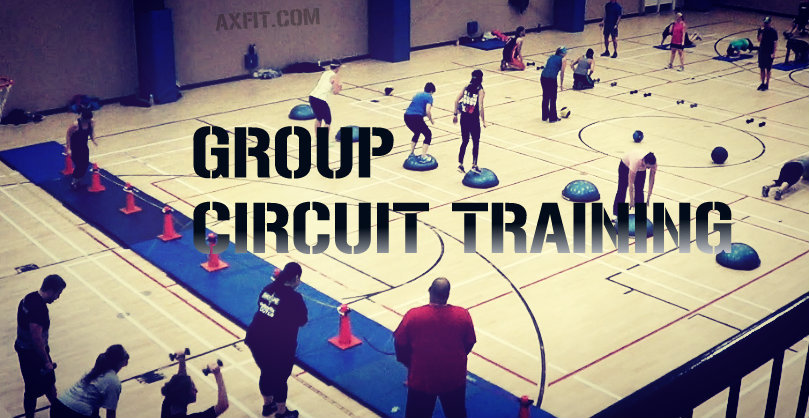
Source: http://EzineArticles.com/4816733
Circuit training is a method of physical training in which a series of exercises are performed continuously (preferably without rest) in a "circuit" fashion. It is usually a whole body exercise programme, meaning that a series of different exercises are selected and which target all the different muscle groups of the human body. The exercises are spread out over the entire body and each muscle group is exercised only once in quick (albeit good form) succession in a circuit style. Circuit training can be performed using one's own bodyweight as the resistance or with hand-held weights such as barbells, dumbells or machines.
Why is it that the exercises should be performed continuously without rest during circuit training?
The answer is this: "The purpose of circuit training is to improve not only our muscular endurance and stamina but also our cardio-respiratory fitness."
What is cardio-respiratory fitness?
The word "cardio" comes from the word "cardiac" which means "heart" and the word "respiratory" comes from the word "respiration" which means "breathing" or "lungs". Thus cardio-respiratory fitness can simply be defined as the ability of the heart and lungs to supply blood and oxygen efficiently to skeletal muscles during prolonged physical exercise without undue stress or exhaustion. So while you are in the midst of a circuit training session, you should be panting for breath and your heart should be beating vigorously pumping blood and oxygen throughout the whole body. You are not doing your circuit training correctly if you do not experience this. The benefits of circuit training are increased muscular endurance and stamina, faster fat loss and stronger and more efficient heart and lungs.
A simple test of your cardio-respiratory fitness can be this:
Climb up a flight of stairs. If you feel unduly tired and out of breath when you reach the top of the stairs, this means that your heart and lungs are not in superb working condition.
A wholebody bodyweight circuit training programme:
- Push ups - 12 repetitions (for the pectoral and tricep muscles)
- Chin ups - 12 repetitions (for the latissimmus dorsi and bicep muscles)
- Squat jumps - 12 repetitions (for the thigh and calf muscles)
- Handstand Push ups - 12 repetitions (for the deltoid and tricep muscles)
- Sit ups and leg raises - 12 repetitions each (for the upper and lower abdominal muscles)
This is how the above bodyweight circuit is done:
First do 12 repetitions of push ups. Without pause, do 12 repetitions of chin ups. Without pause again, do 12 repetitions of squat jumps followed by 12 repetitions of handstand push ups and lastly 12 repetitions each of sit ups and leg raises. Notice that in this circuit you are doing a fixed number of repetitions per exercise, namely 12. There is another method of circuit training which is based on a fixed amount of time spent on doing each exercise. Below is an example of this other method.
A timed bodyweight circuit training programme:
- Push ups - 2 minutes (do as many repetitions as possible within this 2 minutes)
- Chin ups - 2 minutes (do as many repetitions as possible within this 2 minutes)
- Squat jumps - 2 minutes (do as many repetitions as possible within this 2 minutes)
- Handstand Push ups - 2 minutes (do as many repetitions as possible within this 2 minutes)
- Sit ups and leg raises - 2 minutes each (do as many repetitions as possible within this 4 minutes)
Total time required for this circuit = 12 minutes
A wholebody barbell or dumbell circuit training programme:
- Bench press (for the pectoral and tricep muscles)
- Bent over row (for the latissimmus dorsi and bicep muscles).
- Squat (for the thigh muscles)
- Military press or Press behind neck (for the deltoid and tricep muscles)
- Leg curls (for the hamstring muscles)
- French press (for the tricep muscles)
- Bicep curls (for the bicep muscles)
- Calf raises (for the calf muscles)
- Inclined sit ups and hanging leg raises (for the upper and lower abdominal muscles)
Here again you can either do a fixed repetition circuit or a timed circuit.
How many circuits should you do in a training session? This is up to the individual but for best results, 2 bodyweight and 2 hand-held weight circuits should be sufficient. Can muscular strength be achieved from circuit training? Yes it can and this is how it is achieved:
1. When doing bodyweight circuit training, alter the exercises slightly so that they become harder to perform. For example, instead of doing two-armed push ups, try doing one-arm or two fingers push ups.
2. To increase your strength when circuit training with weights all you have to do is to increase the poundage used.
Circuit Training is suitable for all sports that are of long duration such as soccer, basketball, wrestling, judo, taekwondo, MMA (mixed martial arts), jiu jitsu and tennis.
Source: http://EzineArticles.com/4816733
Subscribe to:
Comments (Atom)
Popular Posts
-
To use rope-jumping for fitness, you need to be skilled enough to jump continuously for twenty to thirty minutes, and jumping that long and ...
-
Of no other fat-loss activity -- eating less, walking on a treadmill, doing sit-ups -- can it be said that participants eagerly count the mi...
-
Some of the weight loss articles out there these days are getting a little nutty. New scientific studies that shed light on how metabolism w...
-
Aging does not cause you to lose muscles. Loss of muscle is caused by lack of exercise. You can preserve both muscle size and strength by co...
-
Athletes tend to push themselves 120 percent while exercising because their main objective is to jump higher, run faster or become stronger....


