Showing posts with label diet meal plans. Show all posts
Showing posts with label diet meal plans. Show all posts
4 Superfood Swaps to Switch Up Your Favorite Recipes
You probably already know that superfoods should take a starring role on your plate whenever possible. But eating the same thing over and over can get a little, well, dull. If you're looking to change up your healthy go-tos, try these simple swaps that our nutrition director, Jaclyn London, R.D., recommends.
Make it: Brush four filets with one tablespoon each olive oil and lemon juice; top with 1/2 cup sliced almonds; bake at 425°F 12 to 15 minutes. Season to taste. Serves 4.

Make it: Sauté one pound chopped greens, one tablespoon each olive oil and minced garlic, and two tablespoons water. Add 1/4 cup dried tart cherries; cook until fragrant. Serves 4.

Make it: Toast in a dry skillet until fragrant; sprinkle on soups or salads. Or, replace wheat flour with teff flour in a pancake recipe.

Make it: In saucepan, cook one medium onion, grated, in two tablespoons olive oil on medium-high heat for three minutes, or until soft. Stir in one 29-ounce can pure pumpkin, four cups chicken broth, 1/2 cup cream, two tablespoons pumpkin pie spice, and 3/4 teaspoon salt. Bring to simmer, stirring every three minutes. Divide among bowls. Serves 4.

Source: http://www.goodhousekeeping.com/health/nutrition/superfood-swaps
If you like salmon, try arctic char.
Key benefits: This eco-friendly fish is rich in vitamin D and brain-boosting omega-3's.Make it: Brush four filets with one tablespoon each olive oil and lemon juice; top with 1/2 cup sliced almonds; bake at 425°F 12 to 15 minutes. Season to taste. Serves 4.
If you like kale, try mustard greens.
Key benefits: This peppery veggie has phytonutrients and heart-healthy vitamin E.Make it: Sauté one pound chopped greens, one tablespoon each olive oil and minced garlic, and two tablespoons water. Add 1/4 cup dried tart cherries; cook until fragrant. Serves 4.
If you like quinoa, try teff.
Key benefits: A nutty, gluten-free Ethiopian grain, teff is chock-full of iron, fiber, protein, and calcium.Make it: Toast in a dry skillet until fragrant; sprinkle on soups or salads. Or, replace wheat flour with teff flour in a pancake recipe.
If you like sweet potato, try pumpkin.
Key benefits: Fresh or canned, pumpkin is a foolproof side this season. It's loaded with fiber and vitamin A. And it's also a surprising potassium source, which helps stabilize blood pressure.Make it: In saucepan, cook one medium onion, grated, in two tablespoons olive oil on medium-high heat for three minutes, or until soft. Stir in one 29-ounce can pure pumpkin, four cups chicken broth, 1/2 cup cream, two tablespoons pumpkin pie spice, and 3/4 teaspoon salt. Bring to simmer, stirring every three minutes. Divide among bowls. Serves 4.
Source: http://www.goodhousekeeping.com/health/nutrition/superfood-swaps
10 Nutrient-Packed Nut Butters
Branch out from your standard peanut butter spread and give one of these other nutrient- packed nut butters a try.
Peanut butter is one of America's great culinary contributions to the world (in our opinion). And America agrees: In the United States, we consume over 1.5 billion pounds of peanut butter and peanut products every year. That comes out to nearly $800 million in sales annually. Mr. Peanut is making it rain!
But the staple PB&J sandwiches so many of us grew up with are becoming almost retro. Rising rates of peanut allergies and salmonella scares have challenged peanut butter's dominance, making way for a slew of alternative nut butters. Leading the charge is almond butter, but also jockeying for position are cashew, sunflower seed, walnut, soy nut, and sesame seed butter, to name a few.
Despite its seriousness and the rising rates of peanut allergies, only about one percent of Americans suffer from one, and the chance of catching salmonella from a jar of Skippy is miniscule. There was some concern that peanuts were a host for aflatoxins, a certain type of carcinogen mold. But crops are tested regularly for aflatoxins, so those concerns were inflated.
Then why stray from tried-and-true peanut butter? There are plenty of reasons to branch out and explore the varied world of nut butters. To start, consider the nutritional benefits of the alternatives. Almond butter packs three more grams of heart-healthy monounsaturated fat per serving than peanut butter. And walnuts are one of the most omega-3 fatty-acid-rich foods that don't swim in the ocean. (Vegans and vegetarian, holla!) But another compelling reason is that all of these nut butters are delicious in their own right. Sure, they lack the nostalgia of good ol' peanut butter, but each brings something new to the table.
Now, before you decide to go cartwheeling down the nut butter aisle, keep a couple of things in mind. For starters, nut butters are just that: butters. They should be treated as such. No one would eat five or six pats of dairy butter as a "snack." Yet it's tempting to toss the lid off the nut butter jar like an old college Frisbee and idly nom down spoonful after spoonful. Yes, it's good fat, but there's a limit to how much your body needs before it turns into, well, body fat.
Another thing to remember: Always keep it pure. Look for nut butters with as few ingredients as possible. Ideally, the ingredient list on your almond butter reads, "Almonds." End of story. Maybe, "Almonds, salt." But if you see something more along the lines of "Almonds, sugar, hydrogenated vegetable oils, salt, mono and diglycerides, multisyllable-chemical-oil-slick," then put down the jar and look for a product that didn't require people in lab coats to produce it.
Ready to sample the full spectrum of nut butters? Let's take a look at some of the alternatives popping up in markets around the country.
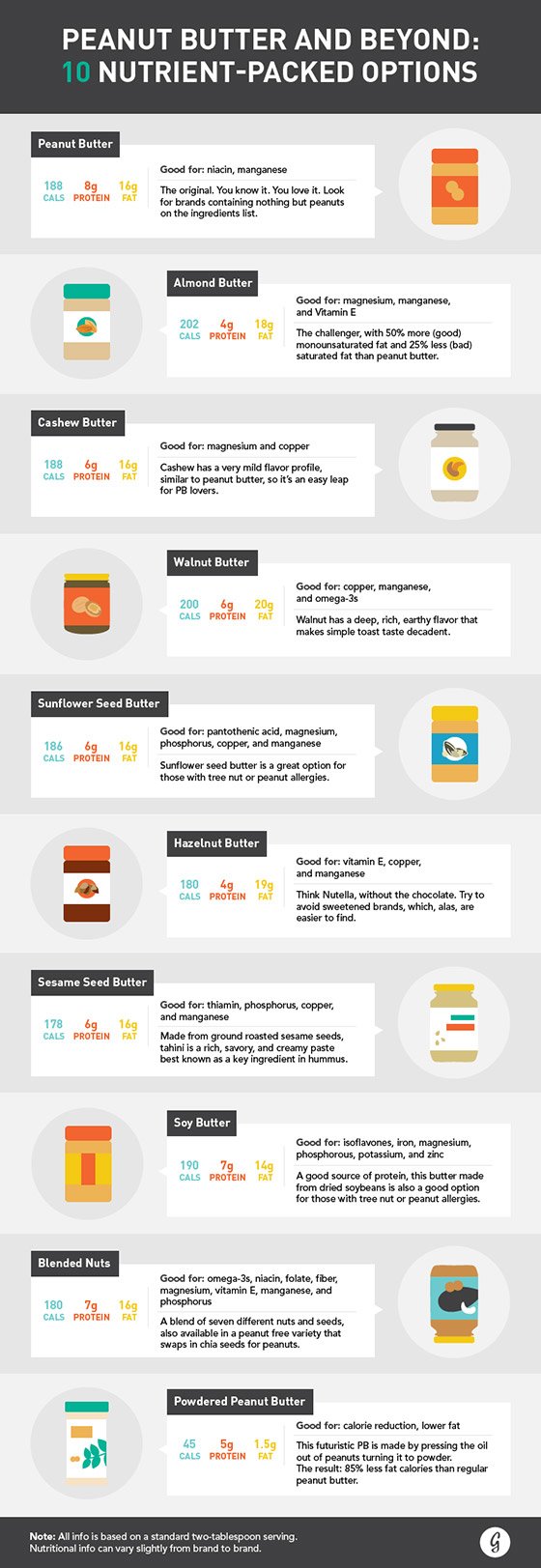
Source: http://www.bodybuilding.com/fun/10-nutrient-packed-nut-butters.html
Peanut butter is one of America's great culinary contributions to the world (in our opinion). And America agrees: In the United States, we consume over 1.5 billion pounds of peanut butter and peanut products every year. That comes out to nearly $800 million in sales annually. Mr. Peanut is making it rain!
But the staple PB&J sandwiches so many of us grew up with are becoming almost retro. Rising rates of peanut allergies and salmonella scares have challenged peanut butter's dominance, making way for a slew of alternative nut butters. Leading the charge is almond butter, but also jockeying for position are cashew, sunflower seed, walnut, soy nut, and sesame seed butter, to name a few.
PICKING THE RIGHT NUT BUTTER FOR YOU
Despite its seriousness and the rising rates of peanut allergies, only about one percent of Americans suffer from one, and the chance of catching salmonella from a jar of Skippy is miniscule. There was some concern that peanuts were a host for aflatoxins, a certain type of carcinogen mold. But crops are tested regularly for aflatoxins, so those concerns were inflated.
Then why stray from tried-and-true peanut butter? There are plenty of reasons to branch out and explore the varied world of nut butters. To start, consider the nutritional benefits of the alternatives. Almond butter packs three more grams of heart-healthy monounsaturated fat per serving than peanut butter. And walnuts are one of the most omega-3 fatty-acid-rich foods that don't swim in the ocean. (Vegans and vegetarian, holla!) But another compelling reason is that all of these nut butters are delicious in their own right. Sure, they lack the nostalgia of good ol' peanut butter, but each brings something new to the table.
Now, before you decide to go cartwheeling down the nut butter aisle, keep a couple of things in mind. For starters, nut butters are just that: butters. They should be treated as such. No one would eat five or six pats of dairy butter as a "snack." Yet it's tempting to toss the lid off the nut butter jar like an old college Frisbee and idly nom down spoonful after spoonful. Yes, it's good fat, but there's a limit to how much your body needs before it turns into, well, body fat.
Another thing to remember: Always keep it pure. Look for nut butters with as few ingredients as possible. Ideally, the ingredient list on your almond butter reads, "Almonds." End of story. Maybe, "Almonds, salt." But if you see something more along the lines of "Almonds, sugar, hydrogenated vegetable oils, salt, mono and diglycerides, multisyllable-chemical-oil-slick," then put down the jar and look for a product that didn't require people in lab coats to produce it.
Ready to sample the full spectrum of nut butters? Let's take a look at some of the alternatives popping up in markets around the country.
Source: http://www.bodybuilding.com/fun/10-nutrient-packed-nut-butters.html
Alkaline diet
Slim down in just 3 days with this alkalising diet
Lacking in energy? Need a quick pick-me-up? This super-fast detox might be exactly what you're after! As well as giving a much-needed boost to energy levels, it'll kick-start your weight loss too. Did we mention that it only takes three days? Yep, really. And, as if that wasn't enough, you'll feel lighter, your skin will be clearer and you'll be much more focused. What are you waiting for?
But never fear! This is where our three-day alkalising juice detox can help, offering fabulous weight-loss gains safely in a short space of time. Results vary from person to person, of course, but you can expect to lose around three pounds on the diet. Skipping solids in favour of a short-term liquid diet can help to reduce the digestive burden, and boost your nutrient intake. Nutrients you get from juices and smoothies are great as they're already in a pre-digested form, so they can be shuttled directly into cells where they can do their work efficiently. Giving your hard-working gut a well-earned rest!
‘When you detox you free up digestive energy and allow the body the time to repair tissues and process toxins that are stored in the liver and the body’s fat cells,’ explains Geeta Sidhu-Robb, nutritionist and founder of Nosh Detox (noshdetox.com). Juicing is also a fabulous way to break any bad habits and get started on the path to inner and outer vitality. Try Geeta’s three-day alkalising detox here.
Blitz the following ingredients:
3 freshly squeezed oranges
5 large strawberries
½ a banana
2tbsp linseeds
1tbsp oats
1 cup water
Blitz the following ingredients:
½ avocado
1 cup wilted kale (blanch in boiling water so that the leaves are tender)
1 large piece of broccoli
1 cup spinach
Juice of 1 lime
Juice of 1 orange
400ml water
Blitz the following ingredients:
1 cup coconut water
1 handful pineapple chunks
1 handful mango chunks
Blitz the following ingredients:
Palm full of almonds
Handful of watercress
Handful of lettuce
Chunks of melon
Juice of 1/2 a lemon
Handful of strawberries
Blitz the following ingredients:
½ avocado
1 handful spinach
1 handful watercress
1 chunk cucumber
Pinch sea salt
Sprinkle cayenne pepper
Blitz the following ingredients:
1 cup unsweetened almond milk
1tbsp chia seeds
2 handfuls of raspberries
½ apple (peeled)
½ avocado
½ cup water
The detox plan
On rising: Warm water with lemon
Breakfast: Early Riser
Morning: Green and Clean
Lunch: Glowy You
Afternoon: Cup of miso soup
Dinner: Evening beauty
On rising: Warm water with lemon
Breakfast: Early Riser
Morning: Green Goddess
Lunch: Tropical Beach
Afternoon: Cup of miso soup
Dinner: Evening Beauty
On rising: Warm water with lemon
Breakfast: Early Riser
Morning: Green & Clean
Lunch: Glowy You
Afternoon: Cup of miso soup
Dinner: Evening Beauty

Lacking in energy? Need a quick pick-me-up? This super-fast detox might be exactly what you're after! As well as giving a much-needed boost to energy levels, it'll kick-start your weight loss too. Did we mention that it only takes three days? Yep, really. And, as if that wasn't enough, you'll feel lighter, your skin will be clearer and you'll be much more focused. What are you waiting for?
Happy tum
An effective digestive system is the key to a slim and trim bod. But sometimes this vital system needs a bit of a nudge to boost its performance. If you can't shift the pounds, or you're feeling bloated or lacking energy, it's time to give your system a break. When you eat, your gut breaks down food, separating nutrients from waste and eliminating leftovers via your bowel. It sounds simple but this fine-tuned process is actually pretty complex. And there are a whole host of ways you could be preventing this system from working at its full capacity. Gulping down food quickly, making poor meal choices and overdoing the alcohol can put a strain on digestion, making it harder to supply your body with the goodies it needs.But never fear! This is where our three-day alkalising juice detox can help, offering fabulous weight-loss gains safely in a short space of time. Results vary from person to person, of course, but you can expect to lose around three pounds on the diet. Skipping solids in favour of a short-term liquid diet can help to reduce the digestive burden, and boost your nutrient intake. Nutrients you get from juices and smoothies are great as they're already in a pre-digested form, so they can be shuttled directly into cells where they can do their work efficiently. Giving your hard-working gut a well-earned rest!
‘When you detox you free up digestive energy and allow the body the time to repair tissues and process toxins that are stored in the liver and the body’s fat cells,’ explains Geeta Sidhu-Robb, nutritionist and founder of Nosh Detox (noshdetox.com). Juicing is also a fabulous way to break any bad habits and get started on the path to inner and outer vitality. Try Geeta’s three-day alkalising detox here.
Early riser
Blitz the following ingredients:
3 freshly squeezed oranges
5 large strawberries
½ a banana
2tbsp linseeds
1tbsp oats
1 cup water
Clean and green smoothie
Blitz the following ingredients:
½ avocado
1 cup wilted kale (blanch in boiling water so that the leaves are tender)
1 large piece of broccoli
1 cup spinach
Juice of 1 lime
Juice of 1 orange
400ml water
Tropical beach
Blitz the following ingredients:
1 cup coconut water
1 handful pineapple chunks
1 handful mango chunks
Glowy you
Blitz the following ingredients:
Palm full of almonds
Handful of watercress
Handful of lettuce
Chunks of melon
Juice of 1/2 a lemon
Handful of strawberries
Green goddess
Blitz the following ingredients:
½ avocado
1 handful spinach
1 handful watercress
1 chunk cucumber
Pinch sea salt
Sprinkle cayenne pepper
Evening beauty
Blitz the following ingredients:
1 cup unsweetened almond milk
1tbsp chia seeds
2 handfuls of raspberries
½ apple (peeled)
½ avocado
½ cup water
The detox plan
Day 1
On rising: Warm water with lemon
Breakfast: Early Riser
Morning: Green and Clean
Lunch: Glowy You
Afternoon: Cup of miso soup
Dinner: Evening beauty
Day 2
On rising: Warm water with lemon
Breakfast: Early Riser
Morning: Green Goddess
Lunch: Tropical Beach
Afternoon: Cup of miso soup
Dinner: Evening Beauty
Day 3
On rising: Warm water with lemon
Breakfast: Early Riser
Morning: Green & Clean
Lunch: Glowy You
Afternoon: Cup of miso soup
Dinner: Evening Beauty
Source: http://www.womensfitness.co.uk/diet-plans/802/alkaline-diet
Eating and exercise: 5 tips to maximize your workouts
Knowing when and what to eat can make a difference in your workouts. Understand the connection between eating and exercise.
Eating and exercise go hand in hand. When and what you eat can be important to how you feel when you exercise, whether it's a casual workout or training for a competition. Consider these eating and exercise tips.
If you exercise in the morning, get up early enough to finish breakfast at least one hour before your workout. Most of the energy you got from dinner the previous night is used up by morning, and your blood sugar might be low. If you don't eat, you might feel sluggish or lightheaded when you exercise.
If you plan to exercise within an hour after breakfast, eat a light breakfast or drink something to raise your blood sugar, such as a sports drink. Emphasize carbohydrates for maximum energy.
Good breakfast options include:
And remember, if you normally have coffee in the mornings, a cup before your workout is probably OK. Also know that anytime you try a food or drink for the first time before a workout, you risk an upset stomach.
Be careful not to overdo it when it comes to how much you eat before exercise. The general guideline:
Eating too much before you exercise can leave you feeling sluggish. Eating too little might not give you the energy to keep you feeling strong throughout your workout.
Most people can eat small snacks right before and during exercise. The key is how you feel. Do what works best for you. Snacks eaten soon before exercise probably won't give you added energy, but they can help keep up your blood sugar and prevent distracting hunger pangs. Good snack options include:
A healthy snack is especially important if you plan a workout several hours after a meal.
To help your muscles recover and to replace their glycogen stores, eat a meal that contains both protein and carbohydrates within two hours of your exercise session if possible. Good post-workout food choices include:
Don't forget to drink fluids. You need adequate fluids before, during and after exercise to help prevent dehydration.
To stay well-hydrated for exercise, the American College of Sports Medicine recommends that you:
Keep in mind that the duration and intensity of your activity will dictate how often and what you should eat and drink. For example, you'll need more energy from food to run a marathon than to walk around the block.
When it comes to eating and exercise, everyone is different. So pay attention to how you feel during your workout and to your overall performance. Let your experience guide you on which pre- and post-exercise eating habits work best for you. Consider keeping a journal to monitor how your body reacts to meals and snacks so that you can tweak your diet for optimal performance.

Source: http://www.mayoclinic.org/healthy-living/fitness/in-depth/exercise/art-20045506
Eating and exercise go hand in hand. When and what you eat can be important to how you feel when you exercise, whether it's a casual workout or training for a competition. Consider these eating and exercise tips.
1. Eat a healthy breakfast
If you exercise in the morning, get up early enough to finish breakfast at least one hour before your workout. Most of the energy you got from dinner the previous night is used up by morning, and your blood sugar might be low. If you don't eat, you might feel sluggish or lightheaded when you exercise.
If you plan to exercise within an hour after breakfast, eat a light breakfast or drink something to raise your blood sugar, such as a sports drink. Emphasize carbohydrates for maximum energy.
Good breakfast options include:
- Whole-grain cereals or bread
- Low-fat milk
- Juice
- Bananas
- Yogurt
- A waffle or pancake
And remember, if you normally have coffee in the mornings, a cup before your workout is probably OK. Also know that anytime you try a food or drink for the first time before a workout, you risk an upset stomach.
2. Size matters
Be careful not to overdo it when it comes to how much you eat before exercise. The general guideline:
- Large meals. Eat these at least three to four hours before exercising.
- Small meals. Eat these two to three hours before exercising.
- Small snacks. Eat these an hour before exercising.
Eating too much before you exercise can leave you feeling sluggish. Eating too little might not give you the energy to keep you feeling strong throughout your workout.
3. Snack well
Most people can eat small snacks right before and during exercise. The key is how you feel. Do what works best for you. Snacks eaten soon before exercise probably won't give you added energy, but they can help keep up your blood sugar and prevent distracting hunger pangs. Good snack options include:
- Energy bars
- Bananas or other fresh fruit
- Yogurt
- Fruit smoothies
- Whole-grain bagel or crackers
- Low-fat granola bars
- Peanut butter sandwiches
A healthy snack is especially important if you plan a workout several hours after a meal.
4. Eat after you exercise
To help your muscles recover and to replace their glycogen stores, eat a meal that contains both protein and carbohydrates within two hours of your exercise session if possible. Good post-workout food choices include:
- Yogurt and fruit
- Peanut butter sandwich
- Low-fat chocolate milk and pretzels
- Pasta with meatballs
- Chicken with brown rice
5. Drink up
Don't forget to drink fluids. You need adequate fluids before, during and after exercise to help prevent dehydration.
To stay well-hydrated for exercise, the American College of Sports Medicine recommends that you:
- Drink roughly 2 to 3 cups (473 to 710 milliliters) of water during the two to three hours before your workout.
- Drink about 1/2 to 1 cup (118 to 237 milliliters) of water every 15 to 20 minutes during your workout. Adjust amounts related to your body size and the weather.
- Drink roughly 2 to 3 cups (473 to 710 milliliters) of water after your workout for every pound (0.5 kilogram) of weight you lose during the workout.
- Water is generally the best way to replace lost fluids. But if you're exercising for more than 60 minutes, use a sports drink. Sports drinks can help maintain your body's electrolyte balance and give you a bit more energy because they contain carbohydrates.
Let experience be your guide
Keep in mind that the duration and intensity of your activity will dictate how often and what you should eat and drink. For example, you'll need more energy from food to run a marathon than to walk around the block.
When it comes to eating and exercise, everyone is different. So pay attention to how you feel during your workout and to your overall performance. Let your experience guide you on which pre- and post-exercise eating habits work best for you. Consider keeping a journal to monitor how your body reacts to meals and snacks so that you can tweak your diet for optimal performance.
Source: http://www.mayoclinic.org/healthy-living/fitness/in-depth/exercise/art-20045506
Subscribe to:
Posts (Atom)
Popular Posts
-
To use rope-jumping for fitness, you need to be skilled enough to jump continuously for twenty to thirty minutes, and jumping that long and ...
-
Of no other fat-loss activity -- eating less, walking on a treadmill, doing sit-ups -- can it be said that participants eagerly count the mi...
-
Dr. Yu-Min Kuo, of the National Cheng Kung University Medical College in Taiwan, has shown how exercise helps to preserve brain function as ...
-
Some of the weight loss articles out there these days are getting a little nutty. New scientific studies that shed light on how metabolism w...
-
Aging does not cause you to lose muscles. Loss of muscle is caused by lack of exercise. You can preserve both muscle size and strength by co...

